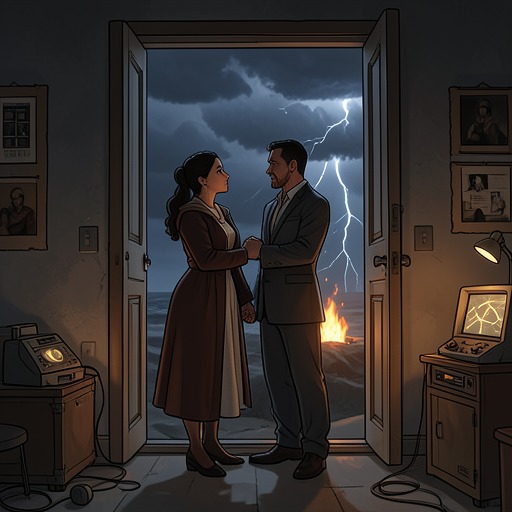
Cane's Proposal Ring
The ExceptionCane’s Proposal Ring is the tangible center of Cane Alexander’s proposal to Jada Stanley: an engagement ring presented when he asks her to move in with him and marry him. Its carefully described design, Jada’s delighted response, and its repeated presence on her hand make it more than a token of the question itself. The ring marks a decisive change in a relationship Cane had once tried to keep within strict limits, giving his promise a visible place in their shared future.
Presentation and design
Cane presents the ring after telling Jada that he wants her to change her address and live with him. He then kneels and asks her to change her last name by marrying him, opening a black velvet box to show the ring. The sequence connects the object to two linked commitments: making a home together and becoming a married couple. The ring is not offered as an isolated gesture, but as the material form of the future Cane has just asked Jada to choose.
The narration gives the ring a precise, personal description. Jada considers it the most beautiful ring she has seen and judges its size to be exactly right—not too large and not too small. Cane removes it from the box and slips it onto her finger. He holds her hand and kisses it before drawing her close. These gestures place the ring between the spoken proposal and their physical embrace: first displayed, then worn, and finally treated with tenderness as part of Jada herself.
Cane later supplies a more specific account of its design while discussing the engagement with Jada and Max Quinn. He recalls that the jeweler described it as a French band with a round halo diamond. His recollection is imprecise about the terminology, but not about the intended effect: he says that the ring was made with Jada in mind and believes, from her expression, that he chose well. The description gives the object a distinctive form while keeping its significance grounded in the couple’s responses rather than in a claim about its price or provenance, neither of which is stated.
Jada’s acceptance and the ring’s aftermath
Jada’s response is immediate and joyful. She exclaims Cane’s name, becomes lightheaded with excitement, and watches as he places the ring on her finger. Her reaction confirms her acceptance of the proposal; the ring changes from an object displayed in the open box into something she chooses to wear. Cane, in turn, watches her hand and kisses it, sharing her attention to the ring rather than treating the proposal as a question already behind them.
The ring remains prominent after the proposal. Later, as Cane and Jada drive through the city, he watches her examine it from the passenger seat. His attention to her looking at it accompanies his sense of peace at the promise of being together permanently. The scene gives the ring an afterlife beyond the proposal: it is now a recurring point of attention in their ordinary time together, and Cane reads Jada’s continued examination as part of the happiness of their engagement.
In another conversation, Jada rests her head against Cane’s chest while her eyes remain fixed on the ring on her left hand. The couple discuss a bachelorette party and Cane jokes about wanting a bachelor party in Las Vegas; Max then offers that they stay at his house and have privacy. The exchange places the ring amid practical talk about celebrations and arrangements. Their future is no longer only a promise made in a private proposal; it is beginning to shape how they speak about the days ahead.
Relationship significance
The ring’s importance becomes clearer against Cane’s earlier reluctance to let intimacy become lasting commitment. He had understood his life as governed by rules, including mistrust and the insistence that each person take responsibility for their own success and failures. He also believed that involvement ended badly and initially wanted only brief encounters with Jada. Later, he admits that his feelings for her exceeded that arrangement and that he had not simply moved on after leaving for Payson. The proposal ring therefore accompanies a change already made in his conduct: he is no longer asking Jada for a temporary place in his life, but for marriage and a shared home.
Its function is not to prove that the couple’s future will be effortless or to establish details the story does not give, such as a wedding date. Instead, the ring makes Cane’s intention legible and records Jada’s answer in an enduring, visible form. Its design is described through the balance Jada finds in its size and the halo detail Cane remembers; its emotional meaning emerges through the repeated acts of looking, holding, wearing, and kissing. In a narrative that has contrasted Cane’s rules against his growing attachment, the ring is the concrete sign that he has chosen commitment over distance.